




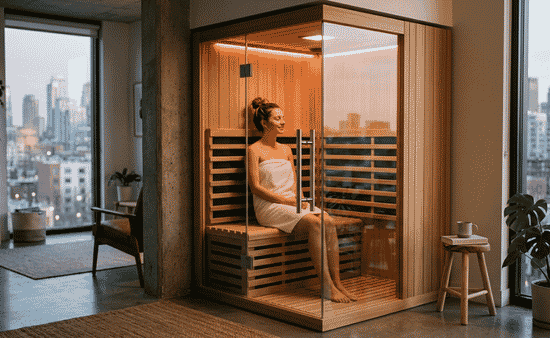
For years, if you wanted a home sauna, you needed a basement. A big one. Custom timber framing, dedicated plumbing runs, a contractor who actually knew what he was doing — the whole production. I’ve talked to homeowners who shelved the idea for a decade simply because they didn’t have the square footage to spare. That’s changed, and it’s changed fast.
Housing units have become smaller in size. Working from home has made the distinction between “I’m stressed” and “I need to decompress” blurry and often in the same space. Therefore, people demanded something different: small and serious recovery devices that do not occupy half of a garage.. Turns out engineers had already been quietly solving that problem.
Spatial Architecture: Engineering Heat into Unused Footprints
Footprint was always the dealbreaker. A traditional sauna build eats up 40 to 80 square feet — more than some studio apartment bathrooms. Modular mini sauna flip that math. Interlocking panel construction gets a fully functional unit down to 9 or 12 square feet. That’s a closet. Genuinely, that’s the footprint of your coat closet.
How? Vertical insulation and zero-clearance framing do most of the heavy lifting. Manufacturers sandwich a high-density, non-toxic insulation core between two layers of softwood — usually Western Red Cedar or Canadian Hemlock — and shave wall thickness down by more than 40%, without losing heat retention.
I’ve seen these tucked into bedroom corners, old walk-in closets, even the dead space behind a home gym setup. Spaces nobody was using anyway.
Thermal Physiology: Small Volume, Identical Hyperthermic Response

Here’s a myth I hear constantly: smaller saunas, weaker benefits. Not true. Your body doesn’t care how many cubic feet of air surround it. What matters is core temperature and heat shock protein production, and those respond the same whether you’re in a 100 cubic foot box or a 1,000 cubic foot cedar palace. Sweat rate, cardiovascular load, microvascular dilation — all identical once you hit the target thermal zone.
Honestly, compact units often heat faster and more evenly. Less air to warm means the carbon emitters or compact electric heaters can push the room to 150–195°F in a fraction of the time a big room needs. Faster saturation, same mild hyperthermia, same cellular repair kickoff, same endorphin hit. Size just isn’t the variable people think it is.
Electrical Efficiency and Low-Draw Power Dynamics
This is where a lot of projects used to die. Traditional saunas want a dedicated 240-volt, 40-amp subpanel. That means an electrician, a possible main-breaker upgrade, and a bill nobody budgeted for. I’ve watched clients walk away from sauna plans entirely over this one line item.
For those who prefer to enjoy professional facilities instead, Discover the Best Sauna Experience in Melbourne can be a practical alternative to dealing with the electrical requirements of a home sauna.
Mini saunas mostly sidestep it. Plenty run on a standard 120-volt, 15- or 20-amp circuit — the same draw as your espresso machine or a hairdryer. Targeted radiant panels instead of trying to heat a whole room’s worth of air. For renters especially, that’s the whole ballgame: no electrical remodel, no landlord fight, no permit headache.
Modular Versatility: Assembled in Hours, Portable for Life
Built-in saunas are permanent. They’re tied to the house, full stop. Modular units aren’t. Most use heavy-duty internal buckle or latch systems, and two people with basic hand tools can have one fully assembled in under two hours. I’ve seen it done faster.
That portability matters more than people expect. Move apartments? Unlatch it, flat-pack it, take it with you. No wall damage, no flooring scars, no security deposit drama. It stops being a fixture tied to your address and starts being something you just own — like a nice couch, except it sweats you out.
Aesthetic Integration in Minimalist Interior Design

Early versions of these things looked clinical. Boxy, a little sterile, like a medical device someone tried to make cozy. That’s mostly fixed now. Current designs lean hard into clean lines — frameless tempered glass fronts, fasteners hidden from view, nothing bulky.
Soft perimeter LED chromotherapy lighting and matte wood finishes give these units presence rather than clutter. They anchor a room instead of crowding it. And the glass matters more than people assume — without it, a small enclosed box feels claustrophobic fast. With it, light moves through, and the room still feels open.
Cognitive Wellness and Deliberate Digital Detox
There’s a psychological piece here too, and it’s easy to overlook. Open-concept homes are great until you realize work, sleep, and downtime all happen in the same twenty feet of space. Nothing marks a boundary anymore.
A sauna does. Step inside a single-person heat box and your brain gets a clear signal: this is different, this isn’t the couch where you scroll your phone.The isolation—glass door, scent of warm cedar, sound of the heater—is enough to strip you away from the digital world and into a state more aligned with parasympathetic relaxation. Fifteen minutes without technology and no cell phone is sufficient for most people.
The Future of Residential Thermal Retreats
Strip away the plumbing requirements, the square footage demands, the electrical panel upgrades — what’s left is a genuinely accessible piece of wellness equipment. Modular mini saunas didn’t reinvent thermal therapy. They just removed every excuse standing between an ordinary apartment and a functioning one. Good design did that, not more space.