




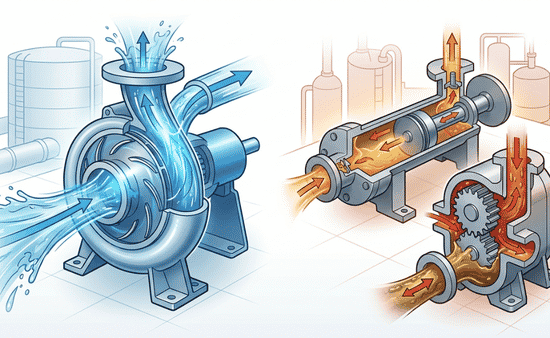
Industrial operations rely heavily on the efficient movement of fluids. Moving everything from clean water to thick chemical sludges requires specialized equipment designed to handle specific physical demands. Pumps serve as the heart of these fluid management systems, keeping processes running smoothly and preventing costly downtime.
Centrifugal Pumps: Kinetic Energy in Action
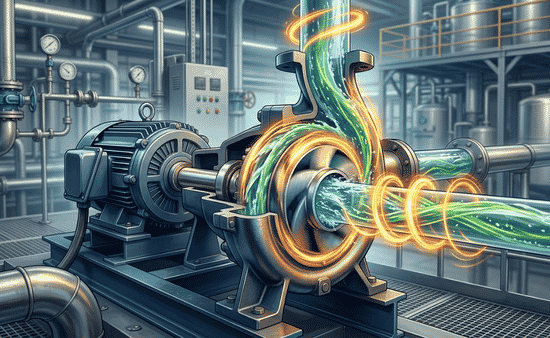
Centrifugal pumps are the most common type of pump used in industrial applications globally. They are favored for their simplicity, reliability, and ability to move large volumes of fluid quickly.
How They Work
These pumps use a rotating impeller housed within a casing. As fluid enters the center of the impeller (the “eye”), the rotational movement flings the fluid outward toward the casing wall. This process converts rotational kinetic energy into hydrodynamic energy, increasing the fluid’s pressure and velocity and forcing it out through the discharge port.
Advantages
The popularity of centrifugal pumps stems from a few significant benefits. They offer an incredibly simple design with very few moving parts, which translates to straightforward maintenance and a long operational lifespan. They also excel at generating high flow rates, making them ideal for moving large quantities of liquid continuously.
Disadvantages
Despite their widespread use, centrifugal pumps have limitations. Their efficiency drops dramatically when handling highly viscous fluids like syrups or heavy oils. They are also sensitive to the Net Positive Suction Head (NPSH); if the pressure at the suction side drops too low, the pump can experience cavitation, causing internal damage. Additionally, most standard centrifugal pumps are not self-priming and require a fluid-filled casing before they can operate.
Common Applications
Because they handle thin, low-viscosity fluids exceptionally well, centrifugal pumps are the go-to choice for municipal water transfer, cooling tower systems, and light chemical processing. You will frequently see them used in HVAC systems and irrigation networks.
Positive Displacement Pumps: Precision and Power
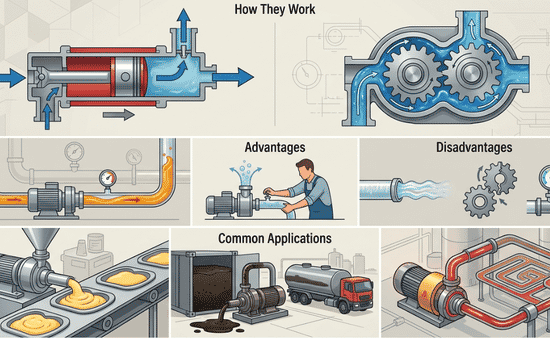
Positive displacement (PD) pumps take a very different approach to fluid movement. Instead of relying on kinetic energy, they mechanically trap and force fluid through the system.
How They Work
A positive displacement pump draws fluid into a cavity and then forces that exact volume of fluid out into the discharge pipe. This action can be achieved through a few different mechanisms. Reciprocating pumps use pistons, plungers, or diaphragms to draw and push fluid. Rotary pumps use rotating cogs, gears, or lobes to trap fluid and carry it from the suction side to the discharge side.
Advantages
These pumps shine when conditions get tough. They handle high-viscosity fluids with ease; in fact, their efficiency often improves as the fluid gets thicker. They provide a constant, predictable flow rate regardless of changes in system pressure. Furthermore, most PD pumps are naturally self-priming and can handle liquids containing trapped air or gases.
Disadvantages
The mechanical action that makes PD pumps so powerful also introduces some drawbacks. Reciprocating models often produce a pulsating flow, which might require dampeners to protect the downstream piping. They generally have more moving parts than centrifugal pumps, meaning they can be more complex and expensive to maintain. They are also restricted to lower overall flow rates.
Common Applications
You will find positive displacement pumps in environments where precision and thick fluid handling are required. They are heavily utilized in food processing for pumping pastes and doughs, in the oil and gas sector for heavy crude transfer, and as hot oil pumps in high-temperature thermal fluid systems.
Key Differences and Comparison
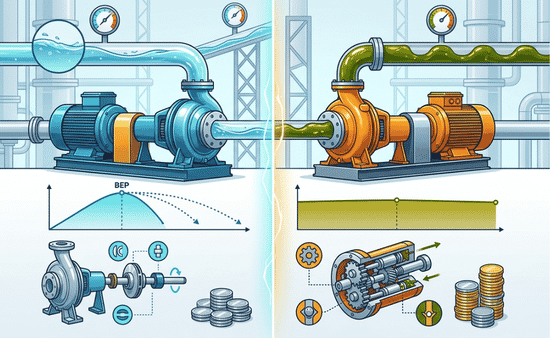
Comparing these two technologies side-by-side reveals exactly how their design dictates their performance.
Flow Characteristics
A centrifugal pump provides a smooth, continuous flow, but that flow rate will decrease as the system pressure (or head) increases. Conversely, a positive displacement pump delivers a constant volume of fluid with every cycle, maintaining a steady flow rate even if the system pressure fluctuates.
Viscosity Handling
Viscosity is a major dividing line. Centrifugal pumps struggle as fluid thickness increases, losing both flow and efficiency due to internal friction. Positive displacement pumps thrive on high viscosity, easily pushing thick, sticky, or dense materials without losing performance.
Efficiency
Centrifugal pumps operate at peak efficiency only at a specific point on their performance curve, known as the Best Efficiency Point (BEP). Deviating from this point causes a drop in efficiency. Positive displacement pumps maintain a relatively stable efficiency curve across a wide range of pressures and speeds.
Maintenance
Because they contain only a few moving parts—primarily the shaft, impeller, and seal—centrifugal pumps are usually easier and cheaper to maintain. Positive displacement pumps contain complex internal mechanisms like gears, valves, and plungers that require tighter clearances and more frequent, specialized maintenance.
Cost Considerations
In terms of initial capital investment, centrifugal pumps are generally more cost-effective. However, lifecycle costs can vary. If you use a centrifugal pump for a high-viscosity application, the energy waste and frequent repairs will quickly outpace the higher initial purchase price of a properly specified positive displacement pump.
Choosing the Right Pump
Selecting the correct pump requires a careful analysis of your system’s specific demands. Look closely at the following factors before making a purchase:
- Fluid Type and Viscosity: Is the fluid thin like water or thick like molasses? Does it contain abrasive solids? Thin liquids lean toward centrifugal; thick or shear-sensitive liquids require a PD pump.
- Flow Rate: Determine how much fluid you need to move. High-volume, continuous transfers are best suited for centrifugal designs.
- Pressure Requirements: If your system operates under high pressure or experiences variable pressure drops, a PD pump will maintain a more consistent output.
- Application Needs: Consider whether the pump needs to be self-priming, or if a pulsating flow will damage your downstream equipment.
Conclusion
Selecting the appropriate industrial pump is a matter of matching mechanical capabilities to fluid properties. Centrifugal pumps offer an elegant, low-maintenance solution for moving large volumes of thin liquids. Positive displacement pumps provide the necessary muscle and consistency for handling challenging, viscous fluids under high pressure.